Electrolyte Filtration
Electrolyte Filtration Equipment for Copper Refineries, Manufactured in India
Sharpenn manufactures pressure filters for copper electrolyte clarification in Navi Mumbai, India, since 1994. 32 units in copper refining, 5 to 350 m3/hr, repeat orders after 20 to 25 years.
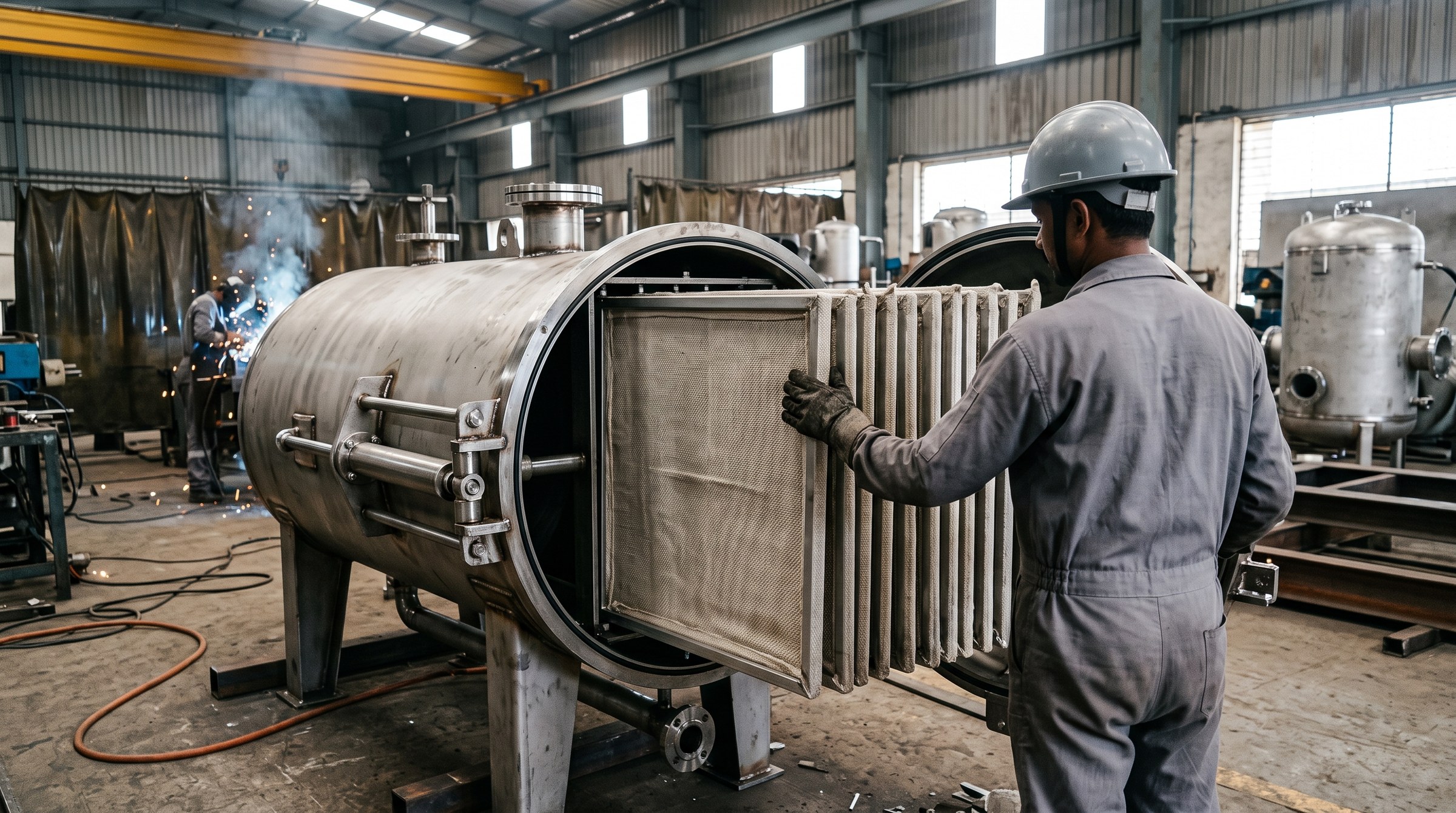
Sharpenn Technologies manufactures pressure filters for electrolyte clarification in copper electrorefining and electrowinning tankhouses, at its own works in the Mumbai region, since 1994. We have supplied 32 units into copper refining across India, Africa and Europe, from 5 to 350 m³/hr, and Indian refineries have placed repeat orders with us after 20 to 25 years of service on the original filters. Every filter is engineered to the duty: flow, electrolyte chemistry, solids load and cake-discharge arrangement are specified per tankhouse, not taken from a catalogue.
This page is for the engineer or purchase lead at an Indian copper refinery, new or established, primary or scrap-fed, who needs to know what we build, what we have supplied, and what to send us for a specification. The process explanations live in our technical articles and are linked where they belong.
What the filter does in a copper tankhouse
Electrolyte circulates continuously between the cells and the circulation tanks, and it carries suspended solids: the fine fraction of anode slimes that does not settle, and other particulates picked up around the circuit. Left in the electrolyte, those solids reach the cathode face and end up in the deposit. The pressure filter is the clarification step that takes them out of a bleed or the full circulating stream, running in precoat or body-feed mode with a filter aid on a disposable cloth septum, so the electrolyte that returns to the cells is clear. Where the filter sits in the circuit, and what it must achieve, is set out in our complete guide to electrolyte filtration for copper refineries; what the solids are and why they stay in suspension is in the article on suspended anode slimes in copper electrorefining.
Our copper refining supply record, in India and abroad
Across all applications, approximately 1,000 units are installed worldwide across 460+ installations. In copper refining specifically, 32 units, at capacities from 5 to 350 m³/hr, with repeat orders placed after 20 to 25 years. The record, by country, capacity and longevity:
Indian copper refineries have run our electrolyte filters since 2002. The first horizontal filters, at 100 and 250 m³/hr, went into two Indian tankhouses in 2002 and 2003.
A 30 m³/hr horizontal filter was supplied to a smaller Indian copper refiner in 2007. Small plants are not an exception in our record; the same design family serves a 30 m³/hr tankhouse and a 250 m³/hr one.
Vertical precoat filters, four at 150 m³/hr, went into a major Indian refinery in 2004, and a 72 m³/hr rotary precoat filter into another in 2007.
Two 350 m³/hr horizontal filters were supplied to a copper operation in the Democratic Republic of the Congo in 2008, and three vertical filters, from 5 to 40 m³/hr, to a Zambian copper producer the same year; the 40 m³/hr unit is still in service.
A 72 m³/hr rotary precoat filter went to Germany in 2007, and the same customer placed a repeat order in 2023.
Indian refineries placed repeat orders in 2022 and 2025 for tankhouses whose original filters had gone in 20, 22 and 25 years earlier, with the original filters still in service when the orders were placed. The replacement decision, and how a plant reaches it, is the subject of when a tankhouse should replace its electrolyte filters.
The same equipment has been run for two decades by plants that then came back for more, and the Indian part of the record is the largest part.
What we build for electrolyte duty
The product is a pressure filter, built in three configurations, and the mode of operation (precoat or body-feed) is a matter of how it is run, not which machine is bought.
Horizontal pressure filters with hydraulic open and close. The larger duties in the record, from 96 to 350 m³/hr. The closure is hydraulic with safety interlocks, so the vessel cannot be opened under pressure and the cake is discharged without breaking a bolted joint by hand.
Vertical pressure filters with eye-bolt closure. Supplied from 5 to 150 m³/hr. The compact choice for a small tankhouse, a bleed stream or a polishing duty.
Rotary horizontal precoat filters. Supplied at around 72 m³/hr in both India and Germany, for a precoat duty.
Across the three, the engineering variables we set per project are filtration area (layouts of 200 m² and 500 m² can be built, in a footprint a cellhouse can accept), the material of the leaves, manifolds and shell (we have built in SS316, SS316L, Hastelloy and titanium; the selection follows the electrolyte's chloride and temperature), the design pressure and the code it is designed to, and the cake discharge arrangement. A pneumatic vibrator or a shell-retraction arrangement is provided where the duty calls for it, and a discharge cycle typically costs zero to one hour of downtime; what that cycle costs a tankhouse, and how the arrangement decides it, is in tankhouse uptime and the cake discharge cycle. Where a plant's priority is production availability above all else, we can engineer towards a nil or very low maintenance configuration for that duty.
Everything is done in-house at our own works: material procurement, fabrication, leaf and manifold manufacture, testing and dispatch. The comparison between running a filter on a precoat and running it on body feed, and what each does to filter aid consumption, is in precoat versus body-feed filtration.
Specifying a filter for a new or small refinery: what to send us
A filter is sized from the duty, so the enquiry that produces a usable proposal is the one that states the duty. Send us:
Design flow to the filter, in m³/hr, and whether it is a bleed stream or the full circulation.
Electrolyte temperature and sulphuric acid concentration, and the copper and chloride levels if known.
Expected suspended solids in the feed, in mg/L, or a description of where the solids come from if the plant is not yet running.
The clarity the tankhouse needs in the return electrolyte.
Available operating pressure, or the pump you intend to use.
Whether the tankhouse is primary (smelter anodes) or scrap-fed (secondary anodes). The slimes load and its character differ, and the filter aid practice follows.
Preferred cake discharge arrangement, and any constraint on footprint, height or crane access.
Site utilities: hydraulic power, compressed air, filter aid handling.
For a new plant where several of these are still open, send what is fixed and say which are not. Our guide walks through the six specification steps in order, from flow and solids through to closure and discharge, in the section on how to specify an electrolyte filter.
Consumables and spares
The septum on a copper electrolyte duty is a disposable filter cloth, replaced on a cycle that the plant sets from its own clarity and pressure-drop record. We supply the cloth and filter bags with the equipment and on reorder, and we can supply filter bags for any make of filter, which is often the first item a plant that already owns another manufacturer's machine buys from us. What decides how long a cloth lasts in this duty, and how to specify one, is in how to specify filter cloth for a copper electrolyte duty.
Spares for our own filters are supplied against the original drawings. The refineries that placed repeat orders after 20 to 25 years were running the original vessels throughout, which is the practical meaning of a spares commitment.
Certification and inspection
Certification is arranged to the requirement of the destination country, through a reputed certification body, and the equipment is supplied certified, as per-project scope. We have designed and built to ASME BPVC Section VIII Division 1, and we have designed to AS 1210 for an Australian specification. For an Indian plant, the code and any inspection the owner or its insurer requires are nominated in the enquiry and we build to them.
For a refinery outside India, the inspection and registration regime is specific to the jurisdiction, and we have set out four of them from the buyer's side: Australia and AS 1210, Singapore's fabrication survey, Zambia's Factories Act and Indonesia's Permenaker 37/2016.
Where to start
A copper refinery in India buying electrolyte filtration has, in us, a manufacturer in the same country with the largest part of its copper record in Indian tankhouses, repeat orders from those tankhouses after 20 to 25 years, and the specification, cloth, uptime and code questions already written up. The equipment is built to the duty, so the duty is what we need first.
Reply with your design flow and electrolyte conditions, and we will set out the filter arrangement and the specification points still to close.

Insights & Article


